IFS Therapy in Liverpool (Internal Family Systems)
I practise Internal Family Systems therapy, known as IFS, at my practice in Garston, Liverpool, and online by Zoom. IFS was developed by Dr Richard Schwartz in the 1980s, and it's highly regarded by many therapists, including Dr Bessel van der Kolk and Dr Janina Fisher. It's now my main approach, and it's at the heart of my work with trauma, complex trauma (CPTSD), anxiety and dissociation. [Book an appointment] or [read about my training and experience].
What is IFS therapy?
nternal Family Systems is a form of Ego State therapy and one of the most up-to-date, robust models of personality we have. It has been developed and adapted since the 1980s into a therapeutic model in its own right, and it's recognised as an evidence-based psychotherapy [check the wording and add a source, e.g. the 2015 listing and the trials on your online page].
The idea is simple: we're all made up of different "parts" (or "aspects") of ourselves. Think of the times you've been in two minds, had an internal battle, or felt many things at once. Like people, parts have their own emotions, behaviours, beliefs and experiences. Working with parts isn't new, and psychotherapists have done their own versions of it for a long time, but IFS gives us a "road map" and a shared language. Because trauma can be so complex and overwhelming, that map helps us understand, process and heal.
IFS is especially helpful if you want positive change, and it works with you and your parts, never against them.
The parts of you: Firefighters, Managers, Exiles and Self
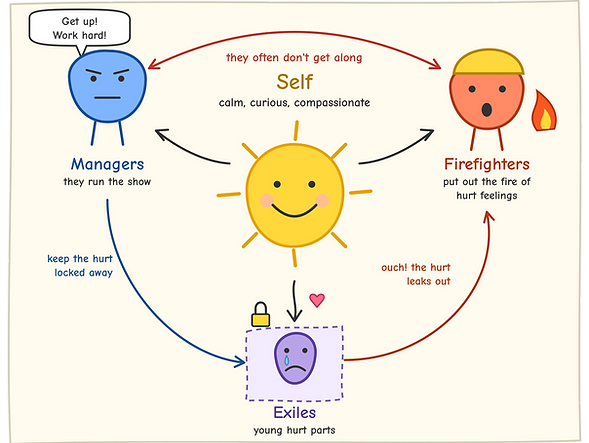
Dr Schwartz's model groups parts into three types, plus Self. See which you recognise in yourself.
Firefighters: help you cope when you feel overwhelmed
Firefighters are high-energy and reactive, and they put out the "fire" of emotion or crisis quickly, for example by dissociating or sending you to sleep. Everyone has parts that fight, flee, freeze, faint or fawn. Some parts drink, take drugs, smoke, binge, obsess, overwork or over-exercise, and some create pain as a distraction or to tell you something. They're the first on the scene in stressful situations and, at the moment they work, they help us feel okay. When they take over, you may feel you have no control, or that you're watching yourself do something. Without them we'd be very stressed indeed, but they don't stop to think, and they often don't realise what their actions cost.
Managers: run the show most of the time
Managers are like your value system. They try to get you through each day with messages such as "Get up, go to work", "Don't worry, just relax", "do this", "do that", "go to therapy", "don't go to therapy". They often pre-empt difficult situations and may reach for food, work, alcohol or drugs to cope. After a Firefighter has taken over, Managers usually return to criticise or shame: "Look, you've done it again". They're trying to help, but they can create conflict in the system, and they're often exhausted from working so hard for so long. These parts often need some therapy themselves.
Exiles: parts that have been hurt, rejected or abandoned
Exiles are younger, wounded parts, frozen in time by historical hurt, abandonment and trauma. Managers and Firefighters keep them out of awareness with messages like "Cheer up, it wasn't that bad", or by drinking to stop the hurt. As children we learn to do things that help us not feel, like eating or behaving in a certain adaptive way. Exiles can bubble up through behaviours, dreams, emotions, flashbacks and physical symptoms. They need more than understanding. They need a different experience, to be released, and to be looked after kindly in the present.
The Self
The Self isn't a part. It's the space inside which parts exist, with no agenda other than love and compassion for parts and for other people's parts. Its qualities are known as the 7 Cs: compassion, calm, clarity, confidence, connectedness, courage and curiosity. When parts feel the Self's energy, healing can happen. We're all born with a Self, and parts exist to help us survive.
How IFS therapy works in sessions
In IFS therapy I'll help you identify and notice your parts, "un-blend" and separate from them, and unburden them through your Self, so you have more access to Self-energy (your best feeling of you). As you do this, you become more aware, clear, confident and calm, and your inner system starts to run more smoothly. IFS promotes healing from the inside, without "going there" until your system is ready. You become the therapist to your own parts, which is part of why many people find it so effective.
Where possible, I suggest 1.5-hour IFS sessions, because the extra time is needed to reach parts and Self and do the work with them. Fortnightly 1.5-hour sessions can be more cost-effective than weekly 50-minute ones, because you can often get further, faster. [See session fees]
Legacy burdens and unattached burdens
Parts can carry burdens. Legacy burdens are things we've inherited from others, for example "I'm anxious just like my mum and grandfather", "I think just like my dad", or "There's a part of me that isn't like me at all". Unattached burdens are another idea in IFS. I have worked successfully with both.
What IFS can help with
IFS is a very thorough therapy. Key ways it helps include:
-
Accessing your deeper Self
-
Releasing and healing trauma held in the body (somatic work)
-
Inner child work
-
Memory reconsolidation
-
Working with trans-generational (inherited) patterns
-
"Shadow work"
-
Focusing and self-healing
-
Talk therapy, where it's useful
-
Working with defensive and protective parts, not against them
Whether you'd like to work exclusively in IFS or with an integration of therapies underpinned by IFS theory, you're welcome to work with me.
IFS and Dissociative Identity Disorder (DID)
IFS has its limits, and I'd rather be honest about them. If you have higher levels of dissociation, such as Dissociative Identity Disorder (DID), or suspect you might, IFS alone isn't enough, because the model doesn't fully cover it. Most psychotherapy models don't, and spotting and working with DID takes further specialist training and experience. Many people with dissociation have felt unseen or invalidated in the past, and I want you to feel understood. IFS training gives a good foundation, and I work flexibly with a range of methods, without being prescriptive.
My IFS training and experience
I'm trained in IFS Levels 1, 2 and 3 and masterclasses (including dissociation), as well as in many other counselling and psychotherapy approaches. I've been using IFS since 2019. Before that I practised Person-Centred therapy and other models from 2005. I've seen powerful transformations through IFS and somatic approaches, which is why they're now my main way of working. [See my full experience and training.]
Whoever you choose, a therapist practising IFS should have at least a Level 1 certificate from the IFS Institute or IFS UK [check this], and should be fully qualified, insured and accredited by a professional body such as the BACP, NCPS, UKCP or BSP.
IFS therapy in Liverpool and online
I see IFS clients in person at my practice in Garston, south Liverpool, with a free on-site car park, bus stops two minutes' walk away, and Liverpool South Parkway station 15 minutes on foot. If you're not near Liverpool, I also offer [online IFS therapy by Zoom] through my other website.
Frequently asked questions
What is IFS therapy in simple terms?
It's a form of psychotherapy that helps you understand and heal the different "parts" of you, such as the inner critic, the protector and the part that carries old pain, from a calm, compassionate place called Self.
Is IFS good for trauma?
Many people use it for trauma, complex trauma, anxiety and dissociation. Some people need extra specialist support alongside it, especially with DID.
How long are IFS sessions?
I suggest 1.5 hours where possible, because it gives enough time to reach parts and Self and work with them.
Can I do IFS therapy online?
Yes. I use IFS in person in Liverpool and online by Zoom.
Want to read more?
A good place to start is No Bad Parts by Dr Richard Schwartz. [book image linking to the IFS Institute page] Below is a video of Dr Schwartz, the founder of IFS